Showing posts with label videos. Show all posts

Saturday, 13 February 2016

Day-making ice skating

Apropos my ice skating reference in the previous post, thank you Detlef for sharing this absolutely beautiful performance from the European Figure Skating Championships, by Gabriella Papadakis and Guillaume Cizeron, of France:


Gabriella PAPADAKIS & Guillaume CIZERON - 2016 European Champi...

Gabriella PAPADAKIS & Guillaume CIZERON - 2016 European Championships - FD

Posted by Ice Skating World on Thursday, 4 February 2016


Absolutely beautiful. Not a moment or a movement without meaning. Not a transition in sight. And you'll notice the commentator stops talking, after a while.

Update: I would draw your attention to this interesting interview with their coach from last year.

Saturday, 24 October 2015

I love afterparties (and heels and flats)

I love afterparties - especially when everybody's almost too tired to stand up, but they still want to dance. They just want to dance. They're high as kites on dancing. Somebody DJs. Somebody has a portable speaker. Somehow a room has been found. And it just sort of happens. There's that wonderful no-obligation feeling where everything that was supposed to happen has already either happened, or not, and everything else is a bonus. If only we could bottle that feeling.


It's quite a bit easier, as a follower, to dance close-embrace tango on a bit of a heel, especially at first. To dance well in flat shoes with your feet properly down, you need pretty good posture and technique. Of course, you can do that, and a few women never wear heels at all. Others just don't feel right without heels. Others just see heels in moderation as part of the dressing-up fun, which is where I am most of the time. There are some men I prefer to wear heels for, and it's usually more a matter of dance style than height: if someone throws boleos around my axis then it works more smoothly for me in heels. I'd rather be in flats to lead, but the better the follower, the less it matters. At an afterparty, I'm going to be in flats.

But the point is, I often think flat feet are wonderfully expressive, and these ones are particularly nice, which is why I started videoing them in the first place. Try watching it with the sound off, and notice how much you can hear the music. A minute later I was dancing again.

Sunday, 24 May 2015

Guess the winner

Here's a bit of fun. The Campeonato de la Ciudad de Buenos Aires (City Championship) is different from the Mundial (World Championship) and in my opinion a bit more watchable.

Here are the tango, vals, and milonga finals. The same couple won all three, which apparently isn't what usually happens. Why not watch them and see if you can guess which one it was? I don't know if I would have guessed right or not, because I happened to see who had won before I found these videos (so will you, if you Google it, so don't if you want to play).

All the videos are courtesy of Aires de Milonga, and as far as I can figure out it's okay to embed them. Go ahead and visit the website, there's all sorts of interesting stuff on there. First the tango:


Milonga:


And Vals (this one includes the introduction of the couples - ff to 03:15 to skip that):


There's a copy of the rules and format available at Puntotango.ar - I don't know if it will remain there. The part about what the judges are looking for is headed DEL CERTAMEN (PARÁMETROS DE EVALUACIÓN).

But the reason I posted this is that I really like the result. I really, really like their dancing, and I think they look as though they are dancing for fun with each other rather than trying to show off. As though they are really surprised and delighted to be there, but not letting it get to them. In between dances they do the sorts of things that people normally do when the music stops, like looking a bit hot and out of breath, fidgeting, flapping about and bumping into their neighbours (which incurs no penalty, between tracks). They are very rhythmical and musical; they are not scared to stand still at the right moments. To find the answer you can watch the presentations: either go to Aires de Milonga and scroll down for the whole lot, or watch the first one, the vals, here (04:43 for first place) and the milonga here. Note; there are ties for fifth place in the vals and second place in the milonga. I like the presentations too. Everyone looks so pleased. It must be lovely to have someone in your life who is having such fun and wants the same thing so much.

Sunday, 22 April 2012

Chileans

I was just thinking about how there are some wonderful dancers from Chile; and realised that it's a perfect excuse to post some demo videos I really, really like. Carlitos Espinoza (from Chile) and Mamié Sancy (also from Chile):


I could watch Mamié Sancy for hours. The music goes all the way up from her feet to her embrace. She's well worth a YouTube stalking session. As is everyone else in this post. Here's a great vals with Carlitos.

And here she is with Felipe Zarzar, who I guess is probably also from Chile, but as a quick Google doesn't really tell me, I'll say that I don't know. You know the coolest thing about Mamié Sancy? She has a doctorate in Chemistry and a proper job as a research metallurgist with the Chilean Air Force. Interview at tango-hub here. Shall we try Google Scholar?


I want to watch Carlitos again, this time with Noelia Hurtado. I luuuurve this one. It goes, "Tinnngggg!!"


Alexis Quezada, from Valparaíso. Totally different from all the above, and mesmerising. Since I can do so from personal observation I'll emphasise that he goes in the 'outstanding social dancer' category even more than the 'outstanding demo/pro' category. Céline Giordano is French, as far as I know, and they're based in Barcelona.


I have no clue what is happening here; contiguity, history (one thing after another), or whether somebody did something to make this happen. And really, it's none of my business. I just feel like sending a card to the Republic of Chile saying something like "We have no idea what you're up to over there, but thanks, guys, keep it up".

Thursday, 6 October 2011

Great following, and a playlist

I love the following in this. I just love it. I also think the leader's dance is very well suited to allowing the follower to shine.


I've seen them dancing socially a few times. After some reflection, it occurred to me that I should probably stop staring at Claudio and pay more attention to his partner, but it was very, very difficult to do. I can't help thinking of other people I would go out of my way to see dance with Claudio - ideally, socially - rather than the women they usually perform with, but I leave that as an exercise for the interested reader.

This seems to be the website of their club in Venice. While I was hunting around in it, I found this post: 4 modi di ballare Bahia Blanca (four ways of dancing Bahia Blanca), and if you understand Italian then do read the post and the comments as well as watching all four videos in the playlist. I agree with the consensus there - but I found it interesting to try to describe why. The first one (Chicho Frumboli) is an intentional red herring, I think, it's far more interesting to decide which you like best of the others. If I can work out how to nick the playlist I might do it here.

Saturday, 25 June 2011

Giro mojo

To cheer me up. I know I'll want to watch it again. Hat tip Andreas for finding this.


Fantastic. [Edit: look at 02:10-02:20]

Monday, 14 February 2011

Diego Amado and Valérie Lafore: a Valentine's Card

Here are two little videos of Diego Amado and Valérie Lafore: I've seen him around at European festivals but haven't actually met either of them (I would love to!). I'm interested in these videos because of the contrast of style. There are quite a few dancers who vary how they dance very markedly depending on context, partner, inspiration, mood, their current thinking, whatever. I find this a convincing illustration of just how misleading the concept of 'style' can be if you try to put people in categories based on it.

I love this one:


Love it! It's totally absorbing, I'd be (discreetly - well, ish) watching it work its way around the dancefloor with pure delight. This is the kind of dance where I'd be wondering "what are we doing and how come it's legal? Does anyone even realise how much fun I am having here?"

Now here's another one, a joint demo with Jorge and Maria Dispari, who some of you know. Same man, same woman, different and darker music, different context, noticeably different so-called-style in my view, perhaps coming mostly from a different pattern of choosing what to use in the music (more in the vein of what Jorge Dispari does, to be exact, which I perceive as dancing to less of it - as a style choice).


This dance is great looking, and very well-dressed, but I'm not gonna rip its tie off, or even give it a Valentine's card, and it probably wouldn't fancy me either. Nothing wrong with it, great quality, but it's  different and not quite my type. I know some regular readers may well prefer this one to the other. It's all good.

But what I find fascinating is that there are quite a lot of people who can technically deliver quite a variety of so-called 'styles', in different contexts, at different times, to different music or with different ideas in mind, to very high standards. I know at least a few myself. I'm not saying there's any reason why you would want to achieve that, beyond insatiable curiosity or sheer bloody-mindedness. It's up to you. But people do it all the time, and it's often a mistake to think about people in such terms.

Anyway you can catch them at Carrément Tango, Marseille.

Wednesday, 8 September 2010

Dance and Male Quality in the Biology Letters

Good Dancing may be sign of Male Health, Scientists Say - BBC:

Dr [Nick] Neave [of Northumbria University] asked young men who were not professional dancers, to dance in a laboratory to a very basic drum rhythm and their movements with 12 cameras.

These movements were then converted into a computer-generated cartoon - an avatar - which women rated on a scale of one to seven. He was surprised by the results.

"We thought that people's arms and legs would be really important. The kind of expressive gestures the hands [make], for example. But in fact this was not the case," he said.
"We found that (women paid more attention to) the core body region: the torso, the neck, the head. It was not just the speed of the movements, it was also the variability of the movement. So someone who is twisting, bending, moving, nodding."

Movements that went down terribly were twitchy and repetitive - so called "Dad dancing".

In the video at that link, Dr. Neave adds:

"The head and the neck and the torso can move around three different angles - forwards and backwards, side to side, turn around - and somebody who's putting all those moves together, in a different way, and making them sometimes big and sometimes small, and showing variability, and flexibility, and creativity in the way that they move their head and their neck and their body, they will be percieved as a good dancer. A bad dancer is someone who engages in very rigid, stereotypical movements. A head nod - a headbanger, for example, is a bad dancer."
Makes sense to me, huh. In so many ways.

I know that science reporting is often pretty dodgy. But in in this case they do tell us what journal the article is in, the Royal Society Biology Letters, which allows me to check the abstract and say that the news article doesn't go much beyond the abstract itself, which (in part) says this:
Linear regression subsequently revealed that three movement measures were key predictors of dance quality; these were variability and amplitude of movements of the neck and trunk, and speed of movements of the right knee. In summary, we have identified specific movements within men's dance that influence women's perceptions of dancing ability. We suggest that such movements may form honest signals of male quality in terms of health, vigour or strength, though this remains to be confirmed.

Indeed, it's possible that moving the core body region in a controlled, varied, creative and twisty way is just genuinely quite difficult, which I think is what they're saying with the technical sense of "honest", and certainly doesn't contradict my personal experience (hello, confirmation bias).

In fact I have several questions about this, such as how the subjects rated their own dancing, how other males rated the dancing, whether there was any definition of dancing, and whether the researchers went beyond the distinction between 'professional' and otherwise. Part of the abstract I didn't quote also implies that the dance of men was found to be more informative than the dance of women, and it would be interesting to know if that was true, or if they didn't measure any female subjects for some reason, or if there just wasn't enough difference between female subjects they measured to be able to tell. I also wonder what the overall goal of the study was and whether it's part of a wider programme of research. The article will be available for free in a year's time; at the moment it costs a rather eye-popping £27, which I don't think I can justify.

And also, why the right knee? Did it matter if they were left-handed? In fact, can you tell from someone's dancing if he's left-handed or not? I know you can with at least some beginner tangueros, who (I remember noticing) if not given definite instruction or obstruction sometimes start with a motion to the right instead of the stereotypical leftward weight-change.

A little bit more digging finds two videos from the study.


There's a lot more in the Letters about animal locomotion, although I don't think any of it changes the lots-of-data-and-no-theory situation.

Monday, 15 March 2010

Soft milonga

Claire Loewe included this video in an email advertising some classes with this couple in a brief visit to London. I won't be taking the class, which is in the wrong part of town for me and at the wrong time, but I watched because I remembered the lady's name from a couple of years ago - at the time she was working with another partner, whose name escaped me until I remembered I'd posted video of them (it was Fernando Sanchez). However, the reason I post this milonga is simply that I love it.


It seems so soft, and tender - it starts with a broad smile from her and then it's unhurried, rhythmic, centred, gentle, totally in line with the feeling I have from this melody - and their remote, studious expressions seem somehow full of joy.

Like the previous video it's in a beautiful room full of beautiful light - since Nayla Vacca is the other element in common I wonder if she is the videographer, and puts a good deal of thought into it. [Edit: on watching again I realise the camera moves very slightly, rather than being on a tripod as I had assumed - so in fact someone else is holding it].

Sunday, 20 December 2009

The sort of thing that you might do for fun

The reason I post this video by Céline Deveze is not that there's any particularly wonderful dancing going on (though most of it looks pretty good to me and it's crowded but doesn't look bumpy), but because everyone seems to be having such fun.


The tango that appeals to me is a relatively simple, physically undemanding dance, with all of the complexity provided by the music, and it's the sort of thing that you might want to do at a party, for fun, with lots of different people, some known to you and some new, sometimes perhaps even in fancy dress.

I think we often make it too difficult and dramatic.

On the other hand, it's rather a subversive thing to do. All these people are much closer together and involved with each other than ballroom dancers, or jivers or lindyhoppers would be. They're much more intensely connected; they are varied in age and in other things, and some of them are very beautifully dressed, or wearing ears or tails or elaborate feather masks or imaginative costumes. And they really look as though they're enjoying it. Naughty, huh? Almost as outrageous as four women swiping a meeting room and knitting together for an hour at lunchtime.

Céline's next "Week-end milonguero," with fancy dress ball, is in the last week of January.

Sunday, 15 November 2009

Adrian and Amanda Costa - now with transcript

Danny asked for a transcript of this interview in the comments on the previous post; I find it pretty hard to hear, myself, so I should think he's right about not being the only one. I've done my best below, I can't hear every word (Amanda is clearest) but I think I've got all the sense.


CLAIRE LOEWE: What is tango-salon for you, if you could essentially say what is important for you about tango-salón?

ADRIAN: For me tango-salón is, the first, be able to respect the people dancing, I mean, what I think about social dancing, about respect for the other ones; is be able to dance with the music and really know what you are doing with the music; is trying to do that with elegance, and make the womans feeling like a queen.

CLAIRE: [To Amanda]: And do you feel like a queen?

AMANDA: Yes, In his arms yes! Depends on the man. But for me, it's more, the walk; and how a couple can be, er, to share the space with the others; and the, the harmony with the couple and with the others and with the music; and not ... with together, not .. in [inaudible] in opposition with all that.

CLAIRE: All of those things are things you've become very well known for here, people are crazy about you, your musicality, I think until you both came here there hasn't been a teacher really, who has clearly spoken about the musicality, [inaudible] you've spoken about the music, and also about the floorcraft, you know, how every single figure fits in with the direction, the first things, it feels like, you've taken tango a level up in London, singlehandedly, the two of you, have done that because your teaching is so clear. So, I really want to thank you for that, if I see the dance which you've brought [inaudible] to our school here, [inaudible] ... hopefully, my students, they're respecting each other, I hope there's no fighting going on as we're talking here, maybe, behind us, there's somebody ... it looks pretty good.

AMANDA: They are walking!

ADRIAN: [inaudible]

CLAIRE: They're in their lanes. And they're doing - how are they doing? [inaudible] the experience of teaching here?

AMANDA: In this place, it's very easy because you gave all the fundamental things, the ball-room, the technique of the ball-room, the embrace, the posture, the walk, so, it's easier. In the other part of London, it's more like a fight. But - we win, together. We win sometimes - not win, it's not a fight, but, we convince to do less, and with more quality, than more, and without quality. There are more ... [fades out].

Saturday, 1 August 2009

Video update - Fred and Caty Romero

I've just found this - it's Caty and Fred Romero's performance at the Festivalito de los Angeles that I went to a couple of weeks ago. This is the 'modern' piece that I mentioned. Thanks to milongaorillera for posting.


I had a poor view from where I was sitting but I was rather moved by this performance. Anyway, I think it's a beautiful close-embrace inward-looking social-style tango with a lot of feeling, to a piece of music quite different from anything else played during the weekend.

Watching it a few times, I notice the tiny slow step at 00:15, which is an example of what they taught in the "harmony and slow movements" class. Finding out how to lead and follow that is one of those deceptively small things that can suddenly give people a lot of new possibilities.

Wednesday, 22 July 2009

Candombe, Canyengue - crowdsourced

Well that worked out well. I asked about candombe and the comments came up with all sorts of interesting things. Here's a followup post with the videos from those comments embedded.

First of all, Simba has a post about a documentary about candombe. That looks like a good place to start if you're interested. Tangocommuter suggested a book, perhaps to be treated with caution.

Maya had taken a candombe class with Paul and Michiko some years ago, and she found two examples of candombe being danced. Game Cat said this one looked like 'giros on E after a pint of Red Bull and bag of sugar ... it also looks fun'. (I thought E just made you warble inanely and love everybody, but I wasn't a Hacienda chick). Anyway I agree with him that it's a bit swingy and jivey and has a very 'live' connection. I also think they're pretty much doing the same things a lot of people who prefer to dance in open embrace do for a fast milonga. I'm not personally crazy about that style as applied to milonga, I prefer close embrace, but I do think it makes a lot more sense here.


Here's Maya's second example, a nice choreography that tells a story about itself, from Companhia Milonga Candombe:


Here are Facundo and Kely Posadas, also mentioned by Maya. I can hear the drums clearly in this one. This is mostly close embrace, but it also feels to me as though it's a little bit more its own thing; clearly there's a strong relationship to milonga, but I think a dancer of cuban salsa could find something familar too.


Now here's something that looks very different, and to music that's also quite different, but has some things in common: Canyengue. I hear brass I mean woodwind instruments, but not drums. This is exactly the same as what I was taught a couple of years ago as Canyengue. Definitely 'centripetal'. Marta Anton and Manolo 'El Gallego':


AFAIK the couple who taught me this (Paul and Michiko again) learned it from Rodolfo and Maria Cieri: the video TC linked to of them is interesting to watch too but has embedding disabled. I think Canyengue is a bit of a reconstruction. Which is fine by me. Anyway I remember it feeling very good, and for some reason doing wonders for my close-embrace tango, I wish I could dance it more often.

Interesting to compare and contrast both music and dances. Right, I seem to have picked up a stupid cough on my holidays, so you can think about the above while I go and breathe eucalyptus in a cloud of steam.

Tuesday, 14 July 2009

Social Dancing - Videos

I've got a couple of nice video clips of social dancing from the mini-festival I went to at the weekend. I didn't think that post was really the place for them. These are from the Sunday afternoon, so it's full daylight and you can see well. There isn't a lot of real social dancing to be seen on video, so I think people need to see this kind of thing. It's informative if you're a beginner, and some of my friends will really like them.

In this one, I wanted to show you the cortina, because it's so pretty the way everyone clears the floor and looks so sociable about it. The tandas were longish, always four tracks. So enough to get used to a new partner and be thoroughly enjoying yourself and satisfied by the end.


This one is from later on, after all the workshops have finished. A lot of people have gone home or sat down for a rest, so the floor is rather empty, but there's some very fine dancing to be found in there, and you get a good view.


I'm not going to say anything else here specifically - I think I'd like to give my readers a chance to watch for themselves. Again, it's informative if you're a beginner - you can watch it a few times and think about what interests you and which couples you like to watch best. It's often hard to judge these things when the movements you see are not ones you know how to accomplish yourself, so don't worry if you are just starting and you don't know what to make of it. You can always come back and watch it again later, you don't have to have an opinion now.

Sunday, 31 May 2009

I've got a dancing flower!

I've got a dancing flower for my birthday!


I've got such a big smile on my face!

Tuesday, 5 May 2009

Apkallu, and other beings

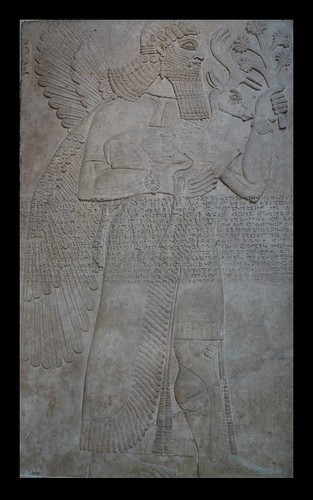
The British Museum, meticulously truthful and scientific, say that they don't know exactly what this being is, and particularly not why it, or, rather, he, is holding a deer and a branch in this posture. (Room 7-8: Assyria: Nimrud). Below is my own photo, taken last week. The black border helps, but their shot is better lit.

Bas-Relief of a winged guardian

But, they continue, it "may be the supernatural creature known as an apkallu." Its job was to guard an entrance to the throne room of Ashurnasirpal II (reigned 883-859 BC) at his palace in Nimrud. I think that when whoever wrote down Genesis originally wrote it down, he probably imagined that the angel guarding the gateway to Paradise looked a lot more like this (or, quite possibly, like this) than, say, Michelangelo thought angels looked.

Despite their lack of beards, however, Michelangelo's angels are clearly male. Perhaps he found female bodies unpleasing, but I think female angels are generally rare in Western art, until the 19th Century, and never on guard duty. The jobs of warrior and messenger were not for women; Victorian female angels do exist, but they are nameless musicians or mourners, like houris without the fun. Anyway, male or not, I have never ever seen an angel in the art of Western Europe represented with a beard. Counter-examples in Comments, please.

Michelangelo's opinions on women were presumably not shared by the sculptor of this dignified marble relief of Sarasvati, 'Vina-pustak dharini' or bearer of the musical instrument (vina). This also is my own picture, it's a pity about the reflections. Theirs here.

Marble deep relief of Sarasvati

A benign Jain goddess associated with knowledge, music and learning, she is now venerated as patroness of DJs*. From Malwa, central India, early 11th century AD, room 33. Presumably she could fly if she wished, but she is neither guard nor messenger, and requires no wings. Her breasts are perfectly level, her hips sway with impossible freedom and fluidity, her feet are firmly rooted in the earth.

[*I made up the bit about the DJs.]

And with that, let's watch Detlef and Melina, who have been languishing in my drafts file for some time, getting mixed up with all sorts of strange company.

Wednesday, 25 February 2009

Ent Tango with Subtitles

The sidebar on YouTube explains that this is a take-home summary of important points for the students of a basic technique class.

It happens to be in French, a language I used to speak quite well, but haven't practiced recently enough for it to feel natural. The language makes a sufficient space between me and the (valuable, clearly-presented) content of this class that I can see how completely hilarious it would look to someone who didn't speak French and didn't dance tango. My favourites are the little bits of interpretive-dance that Detlef can't resist doing to reinforce Melina's points, and the bit where they make rainbows side by side. So, my knitting friends and various relations: enjoy.

For those who do dance tango, I have written out full subtitles below. A few time checks are included. The metaphor of the roots makes me imagine Ents dancing tango, hence the title. Detlef has been kind enough to review my translation, and I've incorporated his corrections. [Edit: couple of further corrections in purple - they affect the meaning.]


MELINA: Ok, let's start with the most important thing, our posture. As always - we close our feet and put ourselves forward a little bit on the front of the foot. Not too much, just a little bit. The heels are free of weight.

DETLEF: and the toes, inside the shoes, stay flexible. So there isn't weight on the toes. That would be too much.

M: and a bit further up, the knees stay relaxed, we want to be able to move them, but we won't dance with bent knees, the legs should be straight, but relaxed. A bit further up again, the pelvis rests in a natural position, it's also relaxed. The pelvis is the heaviest part of the body and that should be relaxed and sinking towards the ground.

D: That is, you leave the pelvis in a natural position, you don't do things like this, you leave the pelvis parallel with the ground, and keep the whole of the lower body very relaxed.

M: all of the lower body is very heavy and anchored in the ground, we imagine as though we had little roots between the earth and the soles of our feet. 01:19 The upper body is going to do something different, with the upper body we're going to elongate ourselves upwards, we make ourselves a little bit bigger than usual, we open the chest, and we try to create a space around ourselves.

D: And like that, starting from the posture of the bus stop, we try to construct the tango posture. And this point, {taps breastbone} now, is in front of the pelvis and not behind.

01:55 M: Imagine, as always, that you are a king, or a queen, and this is the internal posture that helps us communicate with our partner. Now, when you approach the partner, you try to keep this volume, this posture, we want to approach our partners and not abandon our own posture.

02:20 D: so, you take care of yourself first, that's always the fundamental thing. We embrace - it's an embrace like at the airport - and the only thing we change is these two arms. And that's basically all. In this position, we'll later dance.

M: But, for the moment, we're going to show you things in a practice hold so that you can see better.

03:00 M: Ok, now let's start with the first element of tango, the change of weight in place. It's a very small movement from one leg to the other, basically it's a horizontal movement, not up-and-down.

D: Yes, because it's a movement of our axis from here to there, that's to say the weight of our body is moved in a horizontal direction. But to make it clearer that we want to stay in the closed position, we add some information.

M: We'll add a third dimension.

D: The third dimension. You can see it better when we dance like this. The basic movement is horizontal, the shoulders stay parallel with the ground and the the heads stay at the same level. And what we'll do now is enlarge the presence, and we arrive on the other foot as though breathing out. We increase the volume in the chest and we reduce it. We do it like crossing over a little bridge, to go from one foot to the other. And we add that to the horizontal movement to make it clearer that the position stays closed.

M: Now let's distinguish between the change of weight in place and an open step.

D: A sideways step.

M: We're going to use the third dimension again for this movement. 04:45

D: the change of weight, it was, going up over the bridge, arriving here. And when we move from one place to another, we do it by descending to the basement. And we arrive on the ground floor again. And the basement again, and the ground floor, and the first floor makes another change of weight. 05:20 Ground floor, first floor, ground floor, basement, ground floor.

05:29 M: and this technique helps us to communicate with our partner, because what we're going to do in tango is not just lead and follow but communicate. The person who's leading will make a proposal to the person who's following, will sense whether the person who is following accepts that proposition, and then he, the person who's leading, follows the person who's following.

D: In other words, in a step in place, you propose this enlargement of presence, and look how the partners arrive together here in complete synchronisation. And when we do a lateral step, we move together to the basement and arrive at the same time and in the same place. The proposition - you can see. I could make the proposition - she has accepted, but I haven't followed her. So what we want to happen is this: 06:35 I propose - I notice that she is going to accept, and I adapt myself to her movement, and that keeps us in front of each other.

06:50M: we're going to do steps forwards and backwards, and we're going to work on that with another circular movement, the natural counter-movement of the upper body. What does that mean? The countermovement, it's to show, by the movement of your upper body, the movement of your legs. 07:16 A countermovement is when, for example, my right leg comes forward, and the left side of my upper body comes forward with it. The countermovement of our body.

D: Always in opposition. That is, when I want to walk forward with my right leg I'm going to pull back the right shoulder and the left shoulder goes forward a little bit and you can see this torsion in the body. And when you walk, like that, it creates a countermovement.

M: and this countermovement of the body helps us to keep balanced ... D: in equilibrium ... M: and helps us to communicate, because it's with the countermovement that he makes the proposal, and that initiates my step.

D: You can see it here. We've done the change of weight, with this circular movement, and I'm going to propose a backward step to her , by turning. 08:15. And I didn't follow then, but I can - by following her at the same time. But the proposal, which was also the lead for my own leg, was created by the torsion.

M: That means that the movement always starts with the upper body, with the countermovement.

08:40 D: We set up our posture again. There's less distance up here than down there. Change of weight - and we try to walk in a straight line. I invite her - for example here with a change of weight - and I invite her also in a step forward for her.

09:04 M: and I take this space in front of me actively, I don't let myself be pulled.

09:15 D: and the roots in the ground make us always synchronised, that means that the roots of each foot, you have to pull them out and push them in to the earth with each step. She doesn't close her feet as quickly as possible, the roots down there and the roots of my foot have to be pulled through the ground by the countermovement. And that gives us the ability to move together, even very slowly, in a very synchronised way.

END

Melina and Detlef also teach in German and in English.

Thursday, 8 January 2009

Vaccination against bad taste

... and against quite a lot of bad dancing, for women at least.

José Garofalo in the heels, Carlos Stasi leading. Hat tip to TangoCommuter, who adds a bit of context at the link.


In case you feel that your permanent immunity requires a booster shot, José Garofalo does another version here.

I think the parody is stronger in the one with Carlos Stasi, because it's closer to common experience with a man leading, and truth is always funnier. But the second one, with Veronica Alvarenga, is better lit.

(I don't know where he got the shoes.)

Tuesday, 18 November 2008

Another dance of love

Here's a completely beautiful "dance of love" Tango.

The man is Julian Elizari, who teaches at the Dome. The woman I only know as Audrey, she's a regular on the London social scene. She has a stupendous grace and elegance of movement, but the thing I'm really studying in this video is her beautiful, gentle, soft, fluid, connected, lively embrace. I want to be able to do it like that one day.


Hat tip Psyche.

Friday, 10 October 2008

Father and Daughter dance

This is a lovely video from Oscar Casas, who teaches Canadians to dance tango, and does the rest of the world a favour by posting great little summaries on YouTube. It's several fathers and (adult) daughters dancing together, including him and his daughter Sheila. They are in the far left corner at the start - she has a backless black top on. It has a a message from Oscar in the subtitles, which speaks for itself.


I posted this in a conversation on Dance Forums about something else, and someone (AngelHi) pointed out something I hadn't noticed:

there are 4 couples and 3 different embraces/styles&rdquo

Angel went on to remark that some people “get all caught up in closed vs open vs VU style vs ???” and base their argument on “Well, in BsAs....”. I think Angel's point is worth passing around, although I don't hear that kind of argument much here in London. I think it happens less here than where Angel is, for cultural reasons. There is less incentive for people in Britain to assign almost mystical signficance to trivial and frequently-imaginary details of other people's cultural practices. In the USA there are all sorts of reasons why you might want to do that and create carefully-catalogued cabinets of curiosities out of them. There just are.

I only dance with my Dad at weddings. He's quite musical, but doesn't think so himself because some of his siblings are even more so. We do a sort of Random Rock to his brother's big band.