Dancing shoes are a big investment for the beginner. This post may, if you are lucky, help you postpone that investment until you are sure you want to make it.
But the reason I'm doing it now is this: nobody sells nice, women's shoes, that are good for leading. Women's tango practice shoes are designed for following, but not for wearing with a dress. Alternatives are either too delicate (ballet shoes) or just horrible (dance trainers or Greek sandals). It is possible to lead in heels, but difficult. They create mechanical issues that aren't such a problem in following, especially with the knees, and the angles between hips and shoulders.
What I ideally want for leading is a fully flat, feminine dance shoe. And there aren't any. I'm not exactly sure why not, but none of the brands has come anywhere close to acknowledging the possibility of a woman dancing in flat shoes; although women very commonly lead some of the time, socially and in classes*.
These, however, are nearly perfect. They're extremely comfortable, with flexible soles and a not-too-tight elastic band holding them onto the foot. They look nice and are very reasonably priced, too, from Clarks. You can get this style for under £30 in the sale, if you're lucky, and there are several colours and variations.
 |
| Lovely soft flexible shoe, well held on the foot |
The only problem is the soles. They are rubber, which is far too grippy for dancing. Try to dance tango in these, lead or follow, and you'll do some damage to your knees or ankles very quickly. This is the problem with most sporty shoes.
 |
| Rubber soles are too grippy for dancing |
Here is the solution. A roll of stick-on fabric bandage, and a small pair of scissors. What kind of bandage you use, is not that crucial - a flesh colour would be better than white, but I couldn't find any. You don't want any padding, though, just a plain fabric bandage.
 |
| Stretch very gently, stick, and cut roughly |
Cover the soles at the front with the bandage. If it is elastic, stretch it very slightly, as it will stick better that way. But not too much, or it will come off at the edges. You will probably need two bands, and I find it works better if I make the edges meet, rather than overlapping them. Cut it roughly first, then carefully fold it back and trim around the edges of the sole. There's no need to do the heel, unless you want to, as you'll lift it off the floor when you turn anyway.
 |
| Trimming in progress |
Rub the bandage well into the sole. You end up with a sole that's a bit less grippy than a new suede one, but will wear to about the same grip as a somewhat worn leather one. Just replace the bandage if it comes unstuck or you're no longer happy with the grip. This stuff comes in 5-metre rolls.
 |
| The new surface |
While I'm about it, I'll point out that it's totally possible to follow in these. When I do, I take care to get my heels down. Men who follow well never mince about on tiptoes. Like leading in heels, I think it's harder, it's tricky to maintain the right sort of forward energy, but that's all.
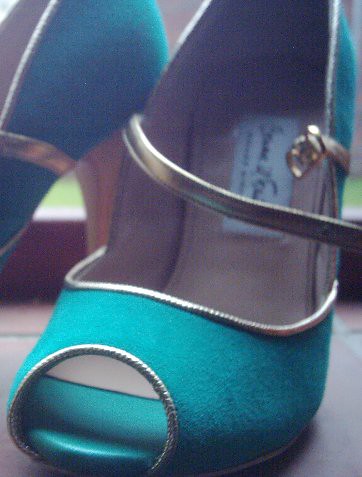
Of course, you can also do this with heeled shoes. If you have a pair of
flexible, comfortable, well-balanced heels that would be perfect if they
weren't too grippy, you can adapt them for dancing in the same way.
Conversely, if you want to wear your beautiful dancing shoes to a party, the same trick works in reverse and protects their soles against the floor. Within reason.
Thanks to
Blaz and
Samar for teaching me this tip!
----
* As an aside, although it's much less usual for men to follow socially, men's dance shoes are available with disguised heels well into the range of what is comfortable for following. But I don't know whether anyone chooses that kind and wears them for that purpose.




 Posts
Posts


