I love this picture, and I loved this performance. There's plenty going on for the audience, but there's so much going on between them. Their connection is electric, whether they're actually touching or not.
This is how good you have to be to turn your backs on each other during a tango performance and never break the connection.
Photo by permission of Carole Edrich (website, photostream). Carole has an exhibition opening on Friday at Zero Sette Restaurant, next to the western entrance of ExCeL .
Tuesday, 4 November 2008


Sunday, 2 November 2008
The meaning of tango - a talk
Anyone who has done both to order knows that writing is denser than speech. It takes a lot less time to read and understand difficult ideas in written form than it does to explain them face to face, and if you write a speech or presentation as though you were writing an essay, you will grossly overrun your time.
Conversely, if you pace a book as though you were giving a lecture, it reads as though you think the reader is a halfwit. This, for me, is the stylistic flaw of The Meaning of Tango, the content of which is interesting but which I have still not managed to read right through. And I think the content deserves better printing and a less timewasting font. But I had a literary, academic education, and not everyone's expectations of books are the same as mine.
However, last week I went to a lecture by the author, and it struck me that it would be very nice if the book were revised for TV. The lecture was more or less a mixture of two chapters, and was mainly about the historical evolution of the music and the dance and their relationship to each other.
A crucial point was that the shortage of women at a certan time, and consequent intense competition among the men, created vigorous selection pressure towards a specific basic technique. This technique is difficult for the leader to learn, requiring a lot of effort and time, but is very hard to improve upon in how it feels for the woman. Ms Denniston distinguished between this universal "Golden Age" technique, and local variations of style, which she showed us with a partner. These, she argued, made no difference to getting dances, except perhaps as matters of local custom or personal preference. A thousand flowers might bloom. But if you did not master the technique, you would be toast.
Most of the rest of the lecture was a chronological survey of music, with some discussion of the Spanish and Italian influences, tango as art song, and the influence of music and dance on each other. This of course is far more interesting and useful with recordings and demonstrations than it is, or can be, written down. And I needn't assume that it's all correct to benefit and want to know more.
I don't know if it's possible to say how far any of the historical information about how people used to dance is actually true. But Ms Denniston has probably done the best that can be done in that direction, by talking to the oldest tango dancers she could find, asking them how it used to be done, and trying to make some sort of sense of what they said. What those people's motivations were in talking to her, how accurate their perceptions and memories, how strict their regard for truth, how wild their flights of fancy, and what they imagined she wanted to hear, are anybody's guess.
But these are things it's worthwhile to research and record, and I'm glad that she's done it. The book includes quite a few assertions I found surprising, some of them contradicting interesting people in interesting ways. For example, she emphatically contradicts what Jorge Dispari has to say about the man's right hand. It also has the usual amount of "Tango does X more than any other dance" which seem like platitudes unless you ask "how do you know?" But those are mere signals of friendship to the reader, and not meant to be literally or critically examined.
The book is still available at milongas around London, and at Amazon.co.uk for, currently, £6.99. But I'd really recommend the lecture more.
The talk was followed by a really nice milonga. Some people had come further than usual for the event, so I met and danced with people I wouldn't normally. If I have inadvertently transmitted the office cold, which I suspect may be about to declare itself, to a new home on the Tyne, I apologise.
Saturday, 1 November 2008
Connection enhancers
Big, fat men are easy to follow. I can just settle like a butterfly, and go.
Getting the same connection with thin, shallow-chested men requires more skill from me. I have to be particularly careful with my posture. I'm dancing closer to the boundary of my skill level, and I'm much more likely to lose it now and then. (Different, or the same, for you? In the Comments, please). It's a common thing with East Asian men, and it is true even if they're really lovely dancers.
My outfit for a Halloween milonga (Gothic look) included a pair of Marks and Spencer's Plastic Tits.
I go up a cup size, and the problem disappears.
I had no idea that this could be solved by shopping. A quality product, £25.
Sunday, 26 October 2008
Raspberry Raffle Shawl
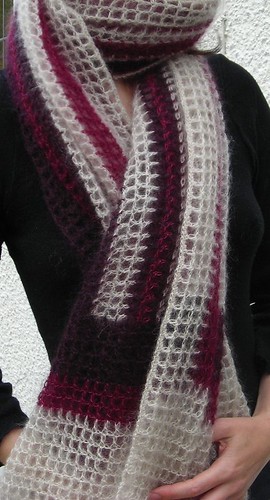
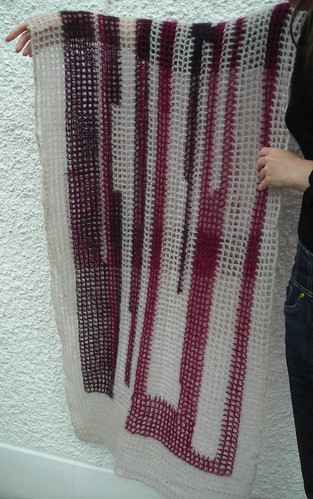
Unique piece by local designer-craftswoman; 70% kid mohair, 30% silk, hand wash, dry flat, reshape whilst damp. It's made of Rowan Kidsilk Haze, which is like wearing a warm, dry cloud.
I love this one. It reminds me of some really beautiful modern paintings, plus it looks like raspberry ice cream and keeps you warm.
Last.FM player thingie
I'm sacking the Last.FM player from the right hand column of this blog and moving it to a post, because it's slow to load and my playlist is never likely to be interesting enough to justify the space. I'd rather use the space for some band links. In case somebody liked it, here it is.
A nice performance
I saw a nice performance tonight by some teachers who were visiting London.
In the tango, there were some lifts and some splits, which are the kind of thing that makes me laugh; and because the performance was to some extent at least improvised, they looked a bit rough. But I found that appealing. I liked it as a whole - it was playful and not overwrought. The daft bits are just fun if they're not taken too seriously, which they weren't.
The milonga was great, and functioned as a very good advertisement for their milonga workshop tomorrow (later today, actually - oops).
Saturday, 25 October 2008
Mr. Wickham's Plan
Since Psyche asked in the previous comments, here's my theory of Mr. Wickham's Plan. I have no idea whether this is argued by any real scholars of Austen. It probably is, as it seems sort of obvious, but I've never read it anywhere else and as far as I know I just made it up. I did write it on a discussion board some years ago, so if you find another version with similar wording, that would be me.
The only explanations we are offered in the book of Mr. Wickham wasting his time with Lydia are that he hopes for money from her family, or that he has no plans to marry her at all, and no purpose in mind but malice and an impulsive attraction.
Both of these are patently inadequate. He surely does “know my father can give her nothing.” Even if “for an attachment such as this, she might have sufficient charms,” he has no obvious reason to want a live-in mistress - even one too ignorant to want paying. He certainly has no good reason to embarrass and offend his commanding officer to such a degree. It is much more convincing to say, as Mr. Gardiner does, that “the tempation is not adequate to the risk” or as Mr. Bennett says, that “Wickham's a fool, if he takes her with a farthing less than then thousand pounds.”
Mr. Wickham's plan is a thing of beauty, because it cannot fail. It is a no-lose proposition. All possible outcomes are good.
Its outstanding elegance of design and execution is appreciated only by three characters; Wickham himself, probably Darcy, though with less pleasure, and Mr. Bennett, whose reasoning must be the same as mine. When Mr. Bennett says that Wickham will always be his favourite son-in-law, I suggest that he is not entirely joking.
Imagine for a moment that, by the time Wickham encounters Lydia on her holiday, he has somehow become aware that Darcy strongly desires Elizabeth. He doesn't have to know anything whatever about their actual conversations. For my argument he need only think - correctly - that Darcy wants Elizabeth very much indeed.
I this this assumption is plausible.
Wickham is the only person in the book who has known Darcy from childhood, with the exceptions of the housekeeper and probably Colonel Fitzwilliam. Wickham is very perceptive and empathic - successfully manipulative people have to be. Wickham has also known, from his own childhood, every single person in Darcy's large household, and he probably knows them quite a bit better than Darcy does, because Wickham's father was the manager and not the owner; a colleague, not the shareholder. He is not short of a contact or two. And he knows Elizabeth.
A brief digression: Wickham started as the son of Darcy's father's valued employee, and since the fluid boundaries of class are one of Austen's characteristic themes I think this is worth keeping in mind. You could wonder what proportion of Darcy's wealth was made by Wickham's father's efforts, and whether Wickham feels, perhaps obscurely, that his own family was entitled to a greater share of it. No such argument clearly entitles Wickham himself to anything in particular, but you can see how it might have an emotional conviction.
The knowledge of Darcy's feelings is in any case pretty general. Darcy has no talent at all for keeping them secret; he only thinks he has. We all seek friends who feed our illusions, and that's one reason why he loves the chronically obtuse Bingley and the intermittently obtuse Elizabeth. Caroline Bingley - who Darcy does not love - has no trouble at all detecting the first signs of interest, and it's only Elizabeth who puts her behaviour down to rudeness.
It's eventually borne in even on the brainless Lady Catherine, though far too late for her to be a source. Her silent daughter - barely perceived - has even more incentive to spot it than Caroline Bingley does, and plenty of opportunity, in good time. It's not a mystery to Colonel Fitzwilliam. We are explicitly told that Charlotte - Mrs. Collins - has considered the idea, but we only hear what she tells Elizabeth, and she's surprised Elizabeth before. Collins has worked it out by the time he writes to Mr. Bennett, and to do so, he must be sure of his ground.
And consider this: if we take Darcy at his word in his great set-piece proposal, he must have been in quite an amusing state for quite a while. Even if he has concealed this fact from all the people I mentioned, and said nothing about it to any living soul, it is absolutely impossible that it was unknown to his valet while they were still at Bingley's house and Wickham was in town. And this man - whose existence is certain, but who we never meet, of whose motivations and views we know nothing, and who Wickham surely knows - probably laughs at Darcy much harder than Elizabeth ever will, if more discreetly.
I don't think that I can point to any particular route. The rumour could well be current among the soldiers and the servants, whose worlds are shut to us, well before Elizabeth goes to Rosings. Wickham could very easily just guess, based on his knowledge of Darcy and of Elizabeth and their whereabouts at different times. Wickham was quite interested in Elizabeth, up to a point. He detects her change in attitude when she returns from Rosings, and he surely puts this down to her conversations with Darcy. So from his point of view, her visit to Rosings is surely the start of a courtship intended to be concluded on her visit to Derbyshire - the fact of which he would surely hear from Lydia.
Now then. You are Wickham. You are confronted with Lydia. You know, or you suspect with a good deal of conviction, that Darcy wants Elizabeth. Even if you have doubts about Elizabeth's view of the matter, you reject them for the same reasons everyone else does, and because you know that Darcy always gets what he wants in the end. So much so that he will even resort to behaving better in order to do so. That's one of the reasons why you just can't stand him. You have a bit of malice to spare for Elizabeth too. You already think they're perfect for each other, and you have just heard that she has gone to Derbyshire, with what appears to you a rather weak excuse. Moreover, you want it to be true, because it gives you a beautiful idea.
Elegant, innit?
You will take to yourself the person of Lydia Bennett, thereby securing the immediate benefit of lots of teenage sex, which is not to be overlooked. But you will not marry, at least for now. If your suspicions are wrong, you've lost little. You've annoyed your colonel, but things are looking bad for you anyway, and you're sure that people are warning the parents of richer prizes. You're not exactly risk-averse, and this is a fine bet. If you're right, there are exactly three next possible moves.
1. Darcy marries Elizabeth anyway. While Lydia is unmarried, you now have unlimited opportunities to humiliate him. Court publicity as much as you can. Don't dump her until a better opportunity presents itself. This outcome is not going to happen, Darcy can't allow it, but if he did, you would still have lost little, and my goodness it would be fun.
2. Darcy does not marry Elizabeth. You have, for the first time ever in your joint lives, permanently prevented Darcy getting what he wants. And how! In this event, you have still lost nothing: just dispose of Lydia as publicly as possible when you get bored, or marry her for whatever you can get if you don't think a better opportunity is coming. Just doing that to Darcy is worth almost more than money, so this is a close second favourite to option 3.
3. Darcy repurchases Elizabeth from you at an appropriate price, in consideration of which you will marry Lydia Bennett. This is by far the most likely outcome, and is, in fact, what happens. The money is useful, and may well be much more than Darcy admits (Mr. Bennett has suspicions on this). It is certainly not much less than you could have hoped to gain by any other marriage.
In (3), you still have part of the benefit of (1) because Darcy cannot allow you to starve, or embarrass him too much, while both wives live. You have part of the benefit of (2) because you have made Darcy pay a very large sum of money for something he would otherwise have got for free. You may have smoothed his path a bit more than you know, but you don't know that, so you don't care. And he will certainly have to continue doing business with you, which he had much rather not.
As far as I can see, those are the only possible outcomes. Either you are paid, or you don't marry and you lose nothing: either Darcy pays, or he loses Elizabeth. The possibility that Darcy might not have got Elizabeth, and you have actually helped him to that goal by assigning her a monetary price, is unknown to you (but remarkably neat from the author's point of view). The rest of it is just haggling, and you're better at that than he is. It really is the perfect no-lose proposition, especially since your failed attempt on Miss Darcy has limited your options in hunting richer meat, and this includes some permanent revenge for that as well.
It is a plot of such perfection that I can't bring myself to disbelive it. I think it is instantly obvious to Mr. Bennet, and he believes it. What about you?
Subscribe to:
Posts (Atom)


 Posts
Posts


