A few of you might enjoy this thread on a Scottish dance discussion board: Driven Wild or To Distraction
It's three years old and they're talking mainly about Ceroc and West Coast Jive, so don't leap in there with tango. But I think it's funny. So what sort of driver, or car, are you?
I thought of the same metaphor myself right near the beginning and quickly realised that although my partner may be steering, I am not just the car but, crucially, the aerodynamicist, all the mechanics, project leader and race engineer. So I put my mind to how to be well balanced and put the power in the right places.
One of my teachers actually used to drive racing cars, long ago, and dancing with him is very curious; there seems to be more time at the edges than there is with other people. He was teaching a milonga class and he could get me to do a whole string of ochos at milonga speed, and suddenly, in the middle, there was a double-time. I couldn't deliver this with anyone else - it was always too late by the time I thought "oops, that was a double-time, too late now". With him it had already gone from his mind to my feet by the time I thought "What was that?" Absolutely no intervention by me. It's slightly disconcerting, but it's very impressive.
Friday, 28 March 2008
Cars & Drivers


Wednesday, 26 March 2008
Make Me Invisible, Please
I was just in a conversation at Johanna's about how exactly you say 'no thanks' to people you just don't want to dance with because they're not fun. There is lots of good advice, some even quite realistic, but the consensus is that what we really need is the Klingon Cloaking Device, or something like it.
Is there potential for miniaturising the Ministry of Defence Invisible Shed? (Article includes photographer's impression of how the shed might look in action).
May I point out that a portable 'device' would painlessly solve the delusional dancer problem without the need for explicit conflict, of which women are generally wary. There is the problem of creeping up on people, but as long as we all have one it doesn't seem too bad.
I did, indeed, once bob right down and crouch behind two chairs at an outdoor festival, keeping very still and thinking invisible thoughts, and hiding from someone who sticks his bottom out, wiggles his arms, rubs his feet on your tights as though he'd found a nice, scratchy tree, and generally makes me go "Ewwwww". It cost me at least an extra half hour of waiting in the cold for a dance, too. I don't know which is more ridiculous, the thought of him wondering where I'd gone, or the thought of him looking at the top of my head and deciding to leave it. Anyway, it was undignified, but it worked.
In my view, research should concentrate on the bracelet-borne, on-demand, Somebody Else's Problem Field. If it could hide an upside-down Italian restaurant full of murderous alien robots in the middle of Lord's during a Test match, surely hiding a hedgehog who asks no more than a pile of warm leaves cannot be too hard. So much more useful than an iPod, which just hides everyone else.
dancetango @ Vino Latino's
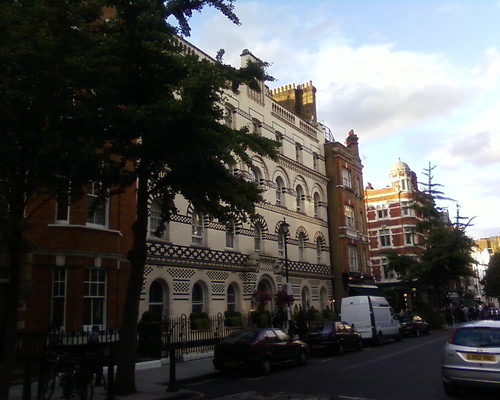 UPDATE 10-July-2011: This milonga has been CANCELLED until further notice due to the venue being refurbished.
Where and When: Every Tuesday at Vino Latino's Wine Bar, downstairs at the Langham Court Hotel, Langham Street, just north of Oxford Circus. [Update 27-Jul-08: added picture.]
The Class: I skipped the class but I've taken it before. Nikki does good basic stuff with a focus on technique. Her teaching style is noisy-but-sound.
What I thought of the DJing: Nice, mildly unusual. A lot of candombe on this particular evening, which I like although not many people know how to dance to it. Roughly four-track sets, no cortinas.
Layout, Atmosphere, Floorcraft: A small, curious underground room with a bar at one side. Two-thirds of the floor is wooden and the other third tiled. They are partly divided by a huge, awkward square pillar to the left of centre, which makes it very tricky to form a sensible line of dance. The bar is not seperate, so you can trip over people socialising and trying to get served. It's also very easy for a couple, or even one person, to block the passage around the pillar. It wasn't crowded, though, so it was manageable and floorcraft was not a major problem. There is a long room off to the side where you can hide your bag, and hang your coat up, and even change your shoes if you prefer not to do that at the side of the dance floor. Plenty of comfortable chairs, pleasant and friendly atmosphere, although too many people concentrating at the bar can start to intrude on the dancing.
Hospitality and Refreshments: Fine. Bar with all kinds of drinks, reasonably priced for the location. The loos were working, supplied, and reasonably clean except for a far-too-small bin, and the taps worked properly.
Website: http://www.dancetango.co.uk/ has recently been prettied up and includes where, when, how much, and contact email, all very easy to find, unless perhaps you turn off images.
Getting in: £8 class and milonga, £4 milonga only.
Getting there and Getting Home: From Oxford Circus, walk up Great Portland or Great Titchfield Street until you reach Langham street. The Langham Court Hotel is the building brilliantly clad in black-and-white tiles, as though it were dressed up for the races in 1901. Go in by the central entrance, and straight down the stairs in front of you. Five minutes from Oxford Circus, and closes at 23:00, so getting home is not a problem.
How it went: Quite a few good dancers turned up for a short stint, and one or two recent beginners were having a pleasant time. I did OK. [Edit: Going more often lately, I've had consistently really nice evenings here, with good dancing, and nice chats with others when sitting. Recently I chatted to a lady from Philadelphia - wearing Tara shoes - who was in London for a few days on business. She had come to Vino Latino's alone, and had a nice time and good dancing.]
DJ Gilda
At the Crypt on Saturday - a DanceTango night - they had Jill Barrett ('DJ Gilda' - try getting a native Spanish speaker to pronounce 'Jill') doing the music. I really enjoyed it, I thought it was good music, intelligently put together. The vaguely reggae cortinas did the job and I even quite liked them. She sometimes DJs and gives classes at the Welsh Centre.
I spoke to her at another dance later in the week and she said she'd put a lot of thought into it and to please tell Nikki I liked it (I already had). I got the impression she'd like to do it more so if you were there and you liked it as well, why not say so.
Sunday, 23 March 2008
On Liquidity and Solvency
This video is Professor Paul Krugman, of the Princeton Economics Department, talking for an hour about housing bubbles, liquidity, and solvency in the banking system. It's out of date, because it was posted before Christmas, on 14th December last year, but he doesn't say anything that isn't still true. It's just that things have moved on a bit since then. You might also know him from his columns and blog in the New York Times, which will bring you up to date.
Watch it for the sheer pleasure of sitting quietly for an hour and listening to a person who deeply understands what he is talking about, and is very, very good at explaining it, talking about something interesting and important.
I can't think what animal it is that Krugman reminds me of. Something with a hairy face and a slightly rolling gait, that looks up at you with curious eyes. Perhaps a badger.
Friday, 21 March 2008
Spem in Alium
If you have been trying out the last.fm "playlist" widget [Edit: now here] down on the right hand side of this blog, you will have found that it mostly plays tangos I like.
However, sometimes it plays something else I like. I am not quite sure how it decides what order to play the playlist in, but if you are really lucky it may play you something completely different - the Tallis Scholars singing Spem in Alium.
This is not my favourite recording of this piece. I prefer the Clerkes of Oxenforde, who sing it higher, faster, and rather less securely; I think that Spem in Alium should be exciting, and a feeling of total security slightly defeats the point.
There are several competing legends about this composition. There's no evidence for any of them, really, and my favourite, which I'll get to, is probably completely made up. It's sometimes said to have been written for the 40th birthday of queen Elizabeth I, but I find the theory that it was written for her elder sister, Mary I, more plausible. Or it may have been written simply because someone else, an Italian, had written a forty-part motet, and the Duke of Norfolk asked whether an Englishman could write anything as good. We know it was written by Thomas Tallis, and you can look up his career, but that's about it.
It's written for forty voices; eight, five-part choirs. If you have the score in front of you, you can see that it makes sense for them to stand in a semicircle or horseshoe shape. The way the music flows down the page tells you that choir 1 stands on one side of the room and choir 8 on the other, with the others in between in order. You might put little gaps in to emphasise some things. You could do it differently, but it would make no sense.
It starts with one voice.
Spem in alium ...
The voices come in one by one, and then the second choir, one by one.
Spem in alium nunquam habui ...
Hope in no other have I had ...
The other voices come in, one voice at a time, working across the room and down the page. You need a strong one just here:
Praeter in te, Deus Israel ...
Save in you, God of Israel ...
This continues until there are forty, each in its own part.
Praeter in te!
After a moment, the music starts back across the room.
Qui irasceris, et propitius eris ...
Who will be angry, and again gracious ...
As it gets there, a tree breaks into blossom.
Et omnia peccata hominem ...
And all the sins of man ...
A fountain dances, a trumpet sounds ...
In tribulatione dimittis ...
In trouble, will forgive ...
The choirs take turns, calling and responding, some are silent, some sing softly ...
In tribulatione dimittis ...
They dance a stately figure.
Domine Deus, Domine Deus ...
Lord God ...
Turning and crossing and courtseying, they answer one another ...
Creator coeli et terrae!
Creator of heaven and earth!
There is a little, tiny pause.
Respice!
Look!
In forty parts, it's spooky.
The wave streams gradually away ...
humilitatem nostram ...
upon our lowliness ...
Silence.
Respice!
You can hear the beat now, a great heart-beat of forty voices, every one seperate and every one dancing its own dance and a dance together, fountains twinkling, fireworks glittering in the sky ...
Respice humilitatem nostram!
And the Duke of Norfolk, in the Long Gallery at Arundel, takes the great gold chain from his own neck and puts it around the bowed head of Mr. Tallis.
I like that legend.
Wednesday, 19 March 2008
Public Funding for Dance Lessons?
The BBC News website reports that a fairly small pot of public money (£5.5m) may be made available to encourage the young to dance. They don't say how, so it's not clear whether there will be grants to pay for a few lessons here and there, or just a really expensive publicity campaign.
I'm right behind that in principle, but I expect the attitude will be (as it is in that article) to treat dancing as just another sport — "Extra centres for advanced training will also be set up to support exceptionally gifted young dancers." There's nothing wrong with making the most of the gifted, but I think taking that attitude too exclusively could be a mistake. It sounds like something that would take up a very large share of the funds, and you would probably get more value out of teaching it as an alternative to sport, as a social activity, an encouragement to likeable behaviour, and also an approach to musical education and self-expression that isn't quite the same as singing or playing an instrument. I don't really feel that this is arts funding, either — dancing is not necessarily a performance for an audience. It's nice to watch good dancers dance, but social dancing is also complete and satisfying for someone who's not even faintly interested in performing or competition.
They also say that dance "is the second most popular school activity after football," but they don't say how far behind it is, how popular football is, or what they mean by "popular", so that sentence is much less interesting than it looks.
Public support for dancing is not a new idea, and wasn't in 1747 when the City Council of Aberdeen employed a dancing-master, the interesting Mr. Francis Peacock, who I blogged about before. I'll quote again from Mr. Peacock's book:
I may here observe, that there cannot be a greater proof of the utility of Dancing, than its being so universally adopted, as a material circumstance in the education of the youth of both sexes, in every civilised country. Its tendency to form their manners, and to render them agreeable, as well in public as in private; the graceful and elegant ease which it gives to the generality of those who practice it with attention, are apparent to everyone of true discernment.


 Posts
Posts


