Showing posts with label quotations. Show all posts

Thursday, 17 April 2014

On writing letters

I have just been re-reading Les Liaisons Dangereuses. An inscription on the title page tells me that I bought it twenty years ago. Published in 1782, it is a fascinating novel concerning the education of women in the author's society. It was made (minus a rather eye-opening sub-plot) into a striking film in 1988, and there are lots of other film versions, including a rather good Korean one in 2003. I read an interesting essay recently which argued that a film by its nature misses the point of a novel in which all the characters construct themselves in the form of their letters, and never even bother to describe themselves or each others' physical appearance. However, all that aside, one of the bits I was looking for just now was this - my translation is below.

LETTRE CV
LA MARQUISE DE MERTEIUL À CÉCILE VOLANGES

[The main part of the letter, instructing the 15-year-old Mlle Volanges on the management of her two lovers and prospective husband, need not detain us.]

P.S. - A propos, j'oubliais... un mot encore. Voyez donc à soigner davantage votre style. Vous écrivez toujours comme un enfant. Je vois bien d'oú cela vient; c'est que vous dites tout ce que vous pensez et rien de ce que vous ne pensez pas. Cela peut passer ainsi de vous à moi, qui devons n'avoir rien de caché l'une pour l'autre : mais avec tout le monde! avec votre Amant surtout! vous auriez toujours l'air d'une petite sotte. Vous voyez bien que, quand vous écrivez à quelqu'un, c'est pour lui et non pas pour vous : vous devez donc moins chercher à lui dire ce que vous pensez, que ce qui lui plaît davantage.

Adieu, mon coeur : je vous embrasse au lieu de vous gronder dans l'espérance que vous serez plus raisonnable.
My translation:

LETTER 105
THE MARQUISE DE MERTEUIL TO CÉCILE VOLANGES
P.S. - A propos, I was forgetting ... another word. Pay more attention to your style. You still write like a child. I know exactly why; you say everything you think, and nothing you do not think. That is all very well between the two of us, who should have nothing to conceal from one another : but with everyone! and with your Lover, above all! You will always sound like a little fool. Think well that when you write to someone, it is for them and not for yourself : so you should try less to say what you think, and more to say what will please them best.
Goodbye, dear heart : I kiss you instead of scolding you, in the hope that you will be more sensible.

Saturday, 14 September 2013

Advice and feedback in 1513

Published five hundred years ago this year, while the early modern world was being born:

XXIII - How Flatterers Should Be Avoided

... there is no other way of guarding oneself from flatterers except letting men understand that to tell you the truth does not offend you; but when everyone may tell you the truth, respect for you abates.  Therefore a wise prince ought to hold a third course by choosing the wise men in his state, and giving to them only the liberty of speaking the truth to him, and then only of those things of which he inquires, and of none others; but he ought to question them upon everything, and listen to their opinions, and afterwards form his own conclusions. ... each of them should know that, the more freely he shall speak, the more he shall be preferred; outside of these, he should listen to no one, pursue the thing resolved on, and be steadfast in his resolutions. He who does otherwise is either overthrown by flatterers, or is so often changed by varying opinions that he falls into contempt.

... A prince, therefore, ought always to take counsel, but only when he wishes and not when others wish; he ought rather to discourage every one from offering advice unless he asks it; but, however, he ought to be a constant inquirer, and afterwards a patient listener concerning the things of which he inquired; also, on learning that anyone, on any consideration, has not told him the truth, he should let his anger be felt.

... this is an axiom which never fails; that a prince who is not wise himself will never take good advice ...

... but if a prince who is not experienced should take counsel from more than one he will never get united counsels, nor will he know how to unite them. Each of the counsellors will think of his own interests ... Therefore it must be inferred that good counsels, whencesoever they come, are born of the wisdom of the prince, and not the wisdom of the prince from good counsels.
Nicolo Machiavelli - The Prince*
There are a few different, interesting, and perhaps not wholly compatible ideas in there. My interpretation for those of us who are not the princes of early-modern Italian city states, but who may still be attempting complex, ambitious or difficult matters:

Seek out information and advice you consider worth hearing. Pay a fair price for it, or reward it in other ways. Take unwelcome information calmly, but do not listen to people who don't know what they are talking about, or to bullshitters who speak only for effect. Do not commit yourself to an idea too soon; once committed, do not vacillate.

Accept that it will all very often be contradictory and difficult to reconcile. Accept that you may make the wrong choice of adviser, and the wrong choice of advice. These are real difficulties; take full responsibility for your enterprise; use reason and experience to overcome them, with time.

Never tolerate a liar.

* The above translation is not my own; it's from my Wordsworth Reference translation, which includes a translator's introduction but doesn't name the translator, who I would credit if I could. As the book was very cheap, I suspect the translation was out of copyright when I bought it in the 90's.

Friday, 9 August 2013

A scarlet ibis

I am a quick, demanding, inattentive reader. When a piece of English prose leaves me sighing with delight, I sometimes like to type it out to get a closer look.

The year is rather vague, but about 1812. Stephen Maturin is an Irish physician, Nathaniel Martin an English clergyman. They are respectively Surgeon and Surgeon's Mate of the British frigate Surprise (Captain Aubrey), which has been damaged by tropical lightning and is putting in to Penedo, Brazil, for repairs. Speaking as we join them is Mr. Allen, an officer, dropping off the two of them, dedicated naturalists, on the beach at dawn.

... Shove off, Macbeth.' And when the boat was some way out on the smooth water he called back, 'Mind the alligators, gentlemen.'

They were standing on a firm white strand and already there was light enough to see that a little way up the slope there began a grove of trees: but surely too high, too massive to be trees. The light increased, and trees they were, palms of an almost unbelievable mass and height, their enormous fan-shaped leaves bursting in a vegetable explosion well over a hundred feet above their heads, and outlined sharp against the greying sky.

'Would they be Mauritia vinifera?' asked Martin in a whisper.

'Mauritia of some kind, sure; but what I cannot tell,' said Stephen.

They walked slowly, reverently into the grove: there was no undergrowth and spring tides or perhaps floods kept the ground quite clean, so that the magnificent trees rose sheer, each some ten yards from the next, a vast grey column.

Their feet made no sound as they paced on; but very soon it was darkness that they were walking into, for the dense fronds intertwined far overhead, and except at its fringes the grove was still filled with warm silent night, the pale trunks soaring up into obscurity. They turned right-handed with one accord and as they reached the outer edge again, facing the river and the strand, the sun heaved up from the eastern sea, sending an instant brilliance across the water to the other bank, no great way off. The reflected light and colour of the far bank fairly blazed upon them as they stood there in the shade of the remaining trees, a bank with a line of shining sand and then a great wall of the most intensely vivid green, an almost violent green, with palms of twenty or thirty different kinds soaring above it, all in the total silence of a dream. Martin clasped his hands as he gazed, uttering some private ejaculations; and Stephen, touching his elbow, nodded towards three trees some way up the river, three enormous cathedral-like domes that rose two hundred feet above the rest, one of them completely covered with deep red flowers.

They took a few more steps through the palms, reaching the white unshaded strand: to the left hand at the water's edge lay a twenty-foot caiman, contemplating the gentle stream, and to the right hand, full in the brilliant sun there stood a scarlet ibis.
Patrick O'Brian, The Far Side of the World.

I point especially to the rhythm of the long paragraph, and how it builds astonishment. This is the end of Chapter 4.

Sunday, 26 April 2009

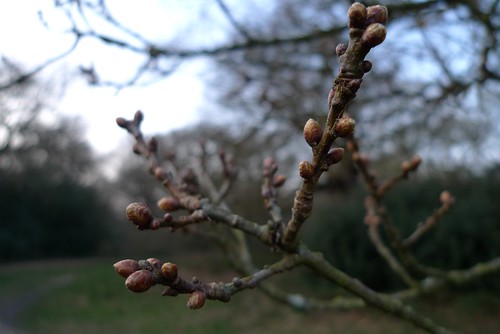
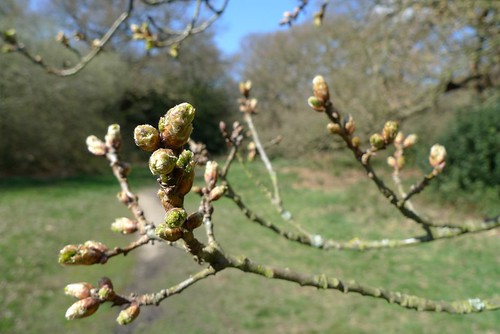
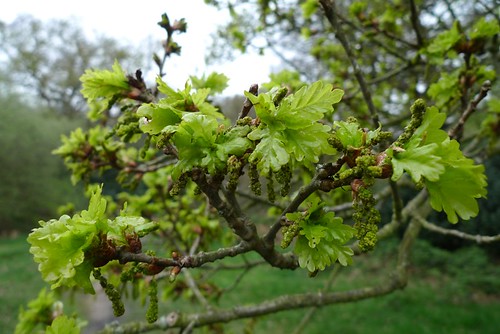
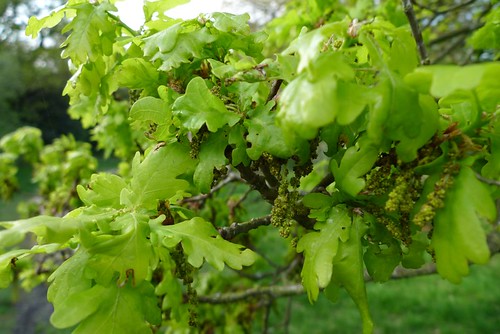
Sunday Photo - Oak

“You can cut

Oak - 21st March
the flower, but

Oak - 4th April
you cannot stop

Oak - 13th April
the coming

Oak - 19th April
of Spring.”

A quotation, whatever its flaws, that has always appealed to me.

Thursday, 12 February 2009

Happy Birthday Mr. Darwin

“... As all the living forms of life are the lineal descendants of those which lived long before the Silurian epoch, we may feel certain that the ordinary succession by generation has never once been broken, and that no cataclysm has desolated the whole world. Hence we may look with some confidence to a secure future of equally inappreciable length. And as natural selection works solely by and for the good of each being, all corporeal and mental endowments will tend to progress toward perfection.

It is interesting to contemplate an entangled bank, clothed with many plants of many kinds, with birds singing on the bushes, with various insects flitting about, and with worms crawling through the damp earth, and to reflect that these elaborately constructed forms, so different from each other, and dependent on each other in so complex a manner, have all been produced by laws acting around us. These laws, taken in the largest sense, being Growth with Reproduction; Variability from the indirect and direct action of the external conditions of life, and from use and disuse; a Ratio of Increase so high as to lead to a Struggle for Life, and as a consequence to Natural Selection, entailing Divergence of Character and the Extinction of less-improved forms. Thus, from the war of nature, from famine and death, the most exalted object which we are capable of conceiving, namely, the production of the higher animals, directly follows. There is a grandeur in this view of life, with its several powers, having been originally breathed into a few forms or into one; and that, whilst this planet has gone cycling on according to the fixed law of gravity, from so simple a beginning endless forms most beautiful and most wonderful hav been, and are being, evolved.”

Concluding paragraphs of The Origin of Species, 1859.


Retyping the above from my copy, I reflect that the sense of 'perfection' is rather specialised, and the sense of 'secure' as broad as it is possible to imagine. The use-and-disuse suggestion is not quite how it works, because genetics hadn't been discovered yet. 'Breathed' is an interesting choice; I think it is a courteous ambiguity, which probably worked for a lot of readers.

The central idea is as powerful, and the concluding sentence as magnificent, as it ever was.

[Update: Musical Protolanguage: Darwin's theory of language evolution revisited. I have wondered recently whether what your native language is has any predictable effect on how you hear the accents in a melody.]

Friday, 23 January 2009

The Bezzle

Not the angle of the edges of a stone - that's bevel - but this:

“To the economist embezzlement is the most interesting of crimes. Alone among the various forms of larceny it has a time parameter. Weeks, months, or years may elapse between the commission of the crime and its discovery. (This is a period, incidentally, when the embezzler has his gain and the man who has been embezzled, oddly enough, feels no loss. There is a net increase in psychic wealth.) At any given time there exists an inventory of undiscovered embezzlement in — or more precisely not in — the country's businesses and banks. This inventory — it should perhaps be called the bezzle — amounts at any moment to many millions of dollars. It also varies in size with the business cycle ...

... Just as the boom accelerated the rate of growth, so the crash enormously advanced the rate of discovery. ... Audits were ordered. Strained or preoccupied behaviour was noticed. Most important the collapse in stock values made irredeemable the position of the employee who had embezzled to play the market. He now confessed.”
John Kenneth Galbraith — the Great Crash 1929

Or, looking at it from another angle, a financial crisis makes a lot of people look very silly.

From the desk of B. Ramalinga Raju - Glad I'm not the auditors.
Santander Praised ‘Impeccable’ Madoff.