No longer a UFO! It's done! Thanks and hugs to Romney for taking the pictures.
This is the most ambitious garment I've ever made, and I've been knitting it since February, on and off. I really learnt a lot. The pattern is vintage, from 1947 if I remember correctly.
I didn't adapt the shape at all, I just went with the pattern. The only change I made was to the colourwork. In the original, the all-over colour pattern, different from the one I've used, is in Fair Isle. I didn't want to do that because:
- The result would be unwearably hot
- The pattern is knitted flat, and there are very good reasons why Fair Isle is usually knitted in the round
- The pattern given is a risky one for Fair Isle, with very long floats
- Fair Isle is very difficult to keep smooth and even at the best of times, and I don't think I can do it with floats that long.
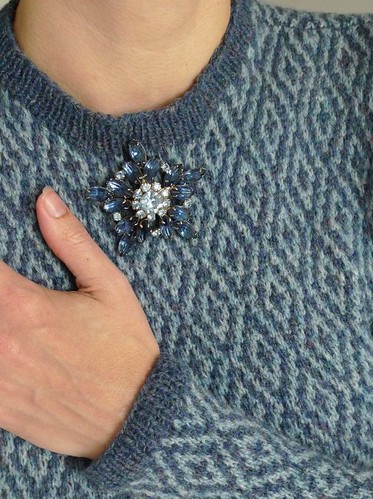
The material is Jamiesons' Shetland Spindrift, which is pretty thin, a bit like sock wool. The brooch is from the vintage counter at John Lewis Oxford Street.
Things I learned include:
Increases and decreases in mosaic knitting
 It's very simple. It works fine if you just ignore one of the colours. If you do the increases and decreases only in the light rows, the dark rows don't count when you're deciding when the next one comes. And don't worry about the colour of the stitch you're increasing or decreasing, just do it close to the edge, take whatever comes up, and let the pattern correct itself over the next couple of rows. The problem vanishes into the seam. Also, the back of the fabric has regular two-by-two stripes, and these make it very easy to count rows.
Change of gauge for shaping
This pattern uses changes of gauge - by taking a smaller needle for a while - for the inward shaping to the waist and for the wrists. This is an extremely elegant solution, I'll certainly use it in my own designs. In a colour pattern like this, it's neatly simple, and it occurs to me that it's also visually slimming at those points because the pattern gets slightly smaller and recedes visually.
Flat colourwork
If you knit a colour pattern flat, you can match it up exactly at the seams and have it look as though the diamonds are coming out of either side of a mirror. This is very pleasing.
Sewing together
Don't bother trying to sew it together with the Shetland Spindrift. It sticks together too much and hasn't got the tensile strength to pull and make an invisible seam. Get some superwash sock wool and use that for the seams. It works.
Sizing
At a first approximation - sample of one - the default size for patterns of this period seems to be a pretty good fit for me. My gauge is slightly looser than specified, but the result is still a very tight fit, as designed - in the picture I've vaguely imitated the pose of the lady on the front of the pattern. I am a dress size 10 UK, or sometimes an 8, depending on the retailer (that might be a 6 or 4 American size.)
Gauge
The small gauge is scary, but the effect is stunning.
Didn't realise that would happen
A high neckline and detailed all-over pattern makes my boobs look bigger.
So, am I going to wear it?
Yes I am, when the weather gets cold. It's definitely designed for a world without central heating, so there aren't that many situations where I can wear it. But if I'm going to be outdoors in the cold and I want to look really stylish, this is the thing to wear. The Shetland wool felts beautifully, so I don't want to have to wash it too much, and I'll be very careful when I do. I'm thinking of making underarm pads to protect it. (On the other hand, I long to make a big piece of the same fabric and felt it into a beautiful handbag). It's also quite short in the body, like most patterns of this period, so there aren't all that many garments I can wear it with. But it will definitely get worn.


 Posts
Posts


