Since Psyche asked in the previous comments, here's my theory of Mr. Wickham's Plan. I have no idea whether this is argued by any real scholars of Austen. It probably is, as it seems sort of obvious, but I've never read it anywhere else and as far as I know I just made it up. I did write it on a discussion board some years ago, so if you find another version with similar wording, that would be me.
The only explanations we are offered in the book of Mr. Wickham wasting his time with Lydia are that he hopes for money from her family, or that he has no plans to marry her at all, and no purpose in mind but malice and an impulsive attraction.
Both of these are patently inadequate. He surely does “know my father can give her nothing.” Even if “for an attachment such as this, she might have sufficient charms,” he has no obvious reason to want a live-in mistress - even one too ignorant to want paying. He certainly has no good reason to embarrass and offend his commanding officer to such a degree. It is much more convincing to say, as Mr. Gardiner does, that “the tempation is not adequate to the risk” or as Mr. Bennett says, that “Wickham's a fool, if he takes her with a farthing less than then thousand pounds.”
Mr. Wickham's plan is a thing of beauty, because it cannot fail. It is a no-lose proposition. All possible outcomes are good.
Its outstanding elegance of design and execution is appreciated only by three characters; Wickham himself, probably Darcy, though with less pleasure, and Mr. Bennett, whose reasoning must be the same as mine. When Mr. Bennett says that Wickham will always be his favourite son-in-law, I suggest that he is not entirely joking.
Imagine for a moment that, by the time Wickham encounters Lydia on her holiday, he has somehow become aware that Darcy strongly desires Elizabeth. He doesn't have to know anything whatever about their actual conversations. For my argument he need only think - correctly - that Darcy wants Elizabeth very much indeed.
I this this assumption is plausible.
Wickham is the only person in the book who has known Darcy from childhood, with the exceptions of the housekeeper and probably Colonel Fitzwilliam. Wickham is very perceptive and empathic - successfully manipulative people have to be. Wickham has also known, from his own childhood, every single person in Darcy's large household, and he probably knows them quite a bit better than Darcy does, because Wickham's father was the manager and not the owner; a colleague, not the shareholder. He is not short of a contact or two. And he knows Elizabeth.
A brief digression: Wickham started as the son of Darcy's father's valued employee, and since the fluid boundaries of class are one of Austen's characteristic themes I think this is worth keeping in mind. You could wonder what proportion of Darcy's wealth was made by Wickham's father's efforts, and whether Wickham feels, perhaps obscurely, that his own family was entitled to a greater share of it. No such argument clearly entitles Wickham himself to anything in particular, but you can see how it might have an emotional conviction.
The knowledge of Darcy's feelings is in any case pretty general. Darcy has no talent at all for keeping them secret; he only thinks he has. We all seek friends who feed our illusions, and that's one reason why he loves the chronically obtuse Bingley and the intermittently obtuse Elizabeth. Caroline Bingley - who Darcy does not love - has no trouble at all detecting the first signs of interest, and it's only Elizabeth who puts her behaviour down to rudeness.
It's eventually borne in even on the brainless Lady Catherine, though far too late for her to be a source. Her silent daughter - barely perceived - has even more incentive to spot it than Caroline Bingley does, and plenty of opportunity, in good time. It's not a mystery to Colonel Fitzwilliam. We are explicitly told that Charlotte - Mrs. Collins - has considered the idea, but we only hear what she tells Elizabeth, and she's surprised Elizabeth before. Collins has worked it out by the time he writes to Mr. Bennett, and to do so, he must be sure of his ground.
And consider this: if we take Darcy at his word in his great set-piece proposal, he must have been in quite an amusing state for quite a while. Even if he has concealed this fact from all the people I mentioned, and said nothing about it to any living soul, it is absolutely impossible that it was unknown to his valet while they were still at Bingley's house and Wickham was in town. And this man - whose existence is certain, but who we never meet, of whose motivations and views we know nothing, and who Wickham surely knows - probably laughs at Darcy much harder than Elizabeth ever will, if more discreetly.
I don't think that I can point to any particular route. The rumour could well be current among the soldiers and the servants, whose worlds are shut to us, well before Elizabeth goes to Rosings. Wickham could very easily just guess, based on his knowledge of Darcy and of Elizabeth and their whereabouts at different times. Wickham was quite interested in Elizabeth, up to a point. He detects her change in attitude when she returns from Rosings, and he surely puts this down to her conversations with Darcy. So from his point of view, her visit to Rosings is surely the start of a courtship intended to be concluded on her visit to Derbyshire - the fact of which he would surely hear from Lydia.
Now then. You are Wickham. You are confronted with Lydia. You know, or you suspect with a good deal of conviction, that Darcy wants Elizabeth. Even if you have doubts about Elizabeth's view of the matter, you reject them for the same reasons everyone else does, and because you know that Darcy always gets what he wants in the end. So much so that he will even resort to behaving better in order to do so. That's one of the reasons why you just can't stand him. You have a bit of malice to spare for Elizabeth too. You already think they're perfect for each other, and you have just heard that she has gone to Derbyshire, with what appears to you a rather weak excuse. Moreover, you want it to be true, because it gives you a beautiful idea.
Elegant, innit?
You will take to yourself the person of Lydia Bennett, thereby securing the immediate benefit of lots of teenage sex, which is not to be overlooked. But you will not marry, at least for now. If your suspicions are wrong, you've lost little. You've annoyed your colonel, but things are looking bad for you anyway, and you're sure that people are warning the parents of richer prizes. You're not exactly risk-averse, and this is a fine bet. If you're right, there are exactly three next possible moves.
1. Darcy marries Elizabeth anyway. While Lydia is unmarried, you now have unlimited opportunities to humiliate him. Court publicity as much as you can. Don't dump her until a better opportunity presents itself. This outcome is not going to happen, Darcy can't allow it, but if he did, you would still have lost little, and my goodness it would be fun.
2. Darcy does not marry Elizabeth. You have, for the first time ever in your joint lives, permanently prevented Darcy getting what he wants. And how! In this event, you have still lost nothing: just dispose of Lydia as publicly as possible when you get bored, or marry her for whatever you can get if you don't think a better opportunity is coming. Just doing that to Darcy is worth almost more than money, so this is a close second favourite to option 3.
3. Darcy repurchases Elizabeth from you at an appropriate price, in consideration of which you will marry Lydia Bennett. This is by far the most likely outcome, and is, in fact, what happens. The money is useful, and may well be much more than Darcy admits (Mr. Bennett has suspicions on this). It is certainly not much less than you could have hoped to gain by any other marriage.
In (3), you still have part of the benefit of (1) because Darcy cannot allow you to starve, or embarrass him too much, while both wives live. You have part of the benefit of (2) because you have made Darcy pay a very large sum of money for something he would otherwise have got for free. You may have smoothed his path a bit more than you know, but you don't know that, so you don't care. And he will certainly have to continue doing business with you, which he had much rather not.
As far as I can see, those are the only possible outcomes. Either you are paid, or you don't marry and you lose nothing: either Darcy pays, or he loses Elizabeth. The possibility that Darcy might not have got Elizabeth, and you have actually helped him to that goal by assigning her a monetary price, is unknown to you (but remarkably neat from the author's point of view). The rest of it is just haggling, and you're better at that than he is. It really is the perfect no-lose proposition, especially since your failed attempt on Miss Darcy has limited your options in hunting richer meat, and this includes some permanent revenge for that as well.
It is a plot of such perfection that I can't bring myself to disbelive it. I think it is instantly obvious to Mr. Bennet, and he believes it. What about you?
Saturday, 25 October 2008
Mr. Wickham's Plan


The brain of the art-ee
I was trying to say that I think a feature of good art is to make good use of the brain that looks at it.
Limerick said that this applies to dance performances, but it immediately struck me, on reading his post, that it applies equally well to painting or writing or sculpture or any kind of art. For example: in Pride and Prejudice, we don't get told exactly why Wickham elopes (I have a beautiful theory). The shading of the Mona Lisa makes her expression appear slightly different depending on how far away you stand, and similar cognitive leverage is the essence of the kind of oil painting that makes people say “just like a photograph”, when, of course, it's absolutely nothing like a photograph. A photgraph leaves out quite different things. Michelangelo's unfinished Deposition has more presence than some of his finished works. Music sounds more interesting when the beat is not always explicit, than when it is.
Anyway. All the people who produced the works above were artists. Some of these are for listeners, some for readers, some for an audience, and I can't even think what the word is for people who look at paintings. I said "art-ee" before realising I had made this word up on the spot. Shall I stick with it or is there a better one?
Wednesday, 22 October 2008
Boring Performances
A couple of weeks ago I was chatting with a salsera friend about performances. I said that I see a lot of performances that are technically impressive, totally professional, and, to me, tedious and embarrassing. I don't think there's anything wrong with show-tango as such; it can be done well, and sometimes it is. I've seen performances I loved. But most of the time, I have every sympathy with a non-dancer who remarked that as far as he could tell, tango was a matter of flicking a few legs and looking a bit silly.
My friend pointed out that there is nothing special here - the same happens in salsa. Maybe the explanation is that dancing well is one thing, but choreography is quite another, and good choreography is very, very difficult. I have seen it done, but not very often. I mostly prefer performances that are wholly or partly improvised, because what they lack in spectacle they more than make up in expressiveness and taste. Perhaps that means good choreography is like a good referee; invisible. Everything flows, and looks as though it came naturally, right then and there. Just performing it is as difficult as saying “To be, or not to be” and giving the entire speech as though the idea had only just occurred to you, and Shakespeare never existed. And most of the time they're trying to write the play as well.
Anyway, I was trying to define to myself how it works; what it is in particular that I don't like, and what I do. The results seem, on reading them over again, to be quite useless. I have been present at shows that repelled me, shows sparkling (in my opinion) with unintentional humour, shows perfectly devoid of musicality, taste, or point, some of them by people who are famous enough that they ought to do better. And I have found myself surrounded by gushing, emotional praise which I could only presume to be sincere. I know what I like - but what can it mean to anyone but me?
I like:
Light and shade.
I don't like:
Continuous drama in a shouting monotone.
I like:
Elegance of movement and clarity of form.
I don't like:
No beat escaping unmolested.
I like:
Chemistry.
I don't like:
Vulgarity.
I like:
The couple looking absorbed, interested in each other, or happy to be dancing together. Some people even manage all three.
I don't like:
The distressed expressions of a pair of breeding coots. Or, worse, the woman looks like a breeding coot and the man looks as though his mind is already on next year's female.
I like:
The woman getting to express her personality without having to SHOUT.
I don't like:
Indiscriminate knees-skywards action. She's a pro and wants you to know she can tickle his right ear with her left heel, both forwards and backwards.
I like:
Connection and intensity.
I don't like:
Broken connections, diversions, mere synchronisation, and fuss.
I like:
Interaction of two personalities.
I don't like:
Empty dramas about dominance and power.
I like:
Emotional content.
I don't like:
Crap acting.
I like:
Differences in personality and structure between tango, milonga, and vals. Differences between one tango and another. Even if I don't know the track or remember the tune, I am left with an impression of what it sounded like that is reinforced by my impression of what it looked like.
I don't like:
A show that has nothing whatsoever to say about the music, merely using it as a framework of the appropriate speed. I am left with the impression that whoever waxed her knicker line did a very good job.
I like:
A dance performed as though to be seen by an informed and intelligent audience, or no audience at all.
I don't like:
A dance performed as though to be seen in the furthest seat at the Millenium Dome, when in fact you are in a small hall in front of a very well-informed audience, many of whom who would really prefer that you got out of the way so they could talk to their friends or go on dancing. And some of whom, though physically unable and aesthetically unqualified to put their legs behind their heads for public entertainment, lead and follow better than you and are more interesting to watch.
Professional dancers work very, very hard for probably not much money. Some of those whose performances I like the least are also those whose business sense, work rate, and other abilities I most respect. But most of them aren't William Shakespeare. What's new?
Tuesday, 21 October 2008
Miniature Pocket Hat
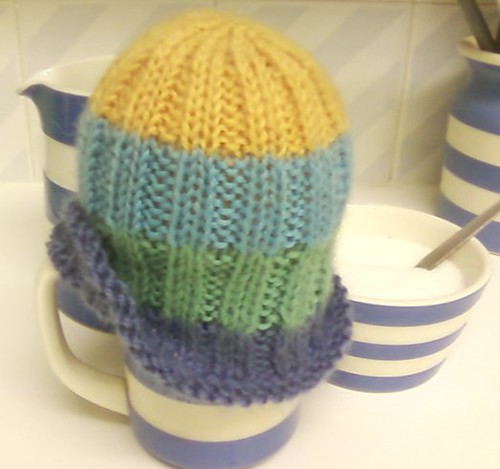 The Techknitting 8-trick Pocket Hat is quite a small project, quick and not at all difficult to do. But it's a fascinating technical tour-de-force; edgeless, jogless, endless, knobless, and devoid of icky dots. It's taught me a lot, and I quite want one for myself. As soon as I've finished my next two projects.
This, modelled by a grapefruit, is my miniature version. I made it in a hurry as a stop-gap because I haven't caught up with all these babies; a special present is in progress. To make a plausible new-born size, I worked in Cygnet Superwash DK on 4mm needles, cast on 52, and worked 8 rows of each colour except the last. It's very stretchy, and I think it should fit, at least for a few weeks, or, I hope, long enough to take a photo. And I'm blogging it because it and the baby should both have arrived by now. (Pattern links: ravelry library, techknitting pattern part 1).
Thursday, 16 October 2008
The Beginner's Questionnaire
Suppose that you've never done a partner dance before. You take a deep breath and you jump in. You don't know what's normal or where you are going, but you are intrepid. How do you know if you've been to a good class? What should you have expected? Did you waste your time?
Well, I know what I think a good class is, and here's my handy Beginner's Questionnaire.
Answers with high numbers are better. Some of the questions won't make sense if you've only taken one class, because there isn't time to deal with what they mention in an hour. Other questions will help you make a decision right away.
However, what I've written reflects my character, experience, and opinions, and you have no way of knowing if I'm right. In fact, Everything below reflects my character. Especially the bitchy bits.
Were you told what to do with your soul, or to imitate the action of a tiger/kitten/river/snake or any other animate or inanimate object whose relation to yourself was purely metaphorical?
- A lot
- Sometimes
- Once or twice
- No.
- No
- Once or twice
- Sometimes
- A lot.
- No
- Mentioned briefly
- Mentioned repeatedly
- Emphasised and acted upon.
- No
- Mentioned briefly
- Mentioned repeatedly
- Emphasised and acted upon.
- No
- A few tips
- Yes, lots of useful advice
- Yes, with encouragement to dance at one or more specific places or times.
- No, we just watched and imitated what we saw
- Once or twice
- Sometimes
- A lot, with different possibilities discussed.
- She should remember to cross at a specific point
- I think she is meant to know when to do it, but I'm not sure how
- Not sure - I'm confused about this
- Do whatever steps are led.
- Once the first couple of steps are led, she should remember to keep going back-side-forward until stopped.
- Basically keep going back-side-forward, but I think it might be different at a more advanced level.
- Not sure - I'm confused about this.
- Do whatever steps are led.
- We learned steps seperately and then worked on synchronising them
- We learned the steps seperately, but the followers were told to wait for the lead before doing them, and the leaders were shown how to lead them
- We learned the steps and then broke them down into leading and following simpler movements
- We were taught to lead and follow simple movements, and we built up the steps from there.
- Not sure what this means
- Not really
- A few tips
- A lot.
- Maybe if she'd taken the same class
- Not really
- Yes, some of it
- Yes, a lot of it.
Did the teacher(s) single out any student(s) in a way you felt was less than kind?
- Yes
- Maybe
- Only as a means of managing attention-seekers
- Never.
- A lot, it was all about him/her and I was annoyed/bored with it
- A lot, but it was useful/funny/informative/I liked it
- A little bit - just to be friendly
- Not much or not at all.
- Yes, leching the students or sleeping off the dope
- Yes, showing off, leching each other, or manipulating people to gratify their vanity
- Yes, something else (are there other possibilities? My goodness, I've got to hand it to them for imagination)
- No.
- No
- A little bit, or only some of that, or not very kindly
- Yes, but not very intelligently, there was a bit of autopilot there
- Yes, and they treated the questions with respect and thought about how to answer them.
- Never
- Occasionally
- With some students/when necessary
- With most or all students.
- Don't think so
- Maybe
- Yes, I think so
- Wow!
- No, I felt bored/mystified/discouraged/ripped off
- Not crazy about it, it was very stressful, or I had a few mishaps
- It was fun or interesting, I felt all right
- I felt good.
[Edit 19th Oct - added 'feedback' question - thanks for reminding me!]
Tuesday, 14 October 2008
Sending Tigers to India
 Some of you may remember the Fair Isle Tiger. He has a rather fierce expression.
He was a present for a baby. The baby belongs to my colleague S, who worked with us here for a while. She quite liked living in Bracknell, especially in summer, but then she went back to Mumbai and did the same work there for a while (it's a big company). While S was here I made the Moomin, which she liked so much that I had to make a companion for her baby when it came.
The tiger travelled in a Jiffy envelope. The address was about ten lines long. I don't think a name, six-character postcode and house number really do the job in India. They usually will, here, even if you forget everything else. We were both a little worried about his possible adventures with customs, security, and immigration, which is why I didn't giftwrap him. I hoped that his modest conveyance and totally relaxed relationship with X-rays, together with the dual-nationality visa of his striped coat, would get him through.
Who could let or hinder that? And here he is with Little S.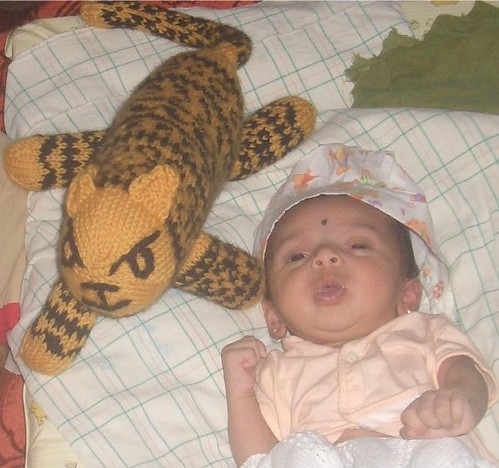


 Posts
Posts


